Posts

The Sea Around Us

Image
The book I read for the 2021 NONFICTION READER CHALLENGE in the category Oceanography is The Sea Around Us , by Rachel Carson, 1961 (with an updated bibliography and introduction in the 2018 edition). I had to pick a book for this category, even though it’s not a subject that I would normally choose to read about. I’m more interested in aspects of the ocean where it meets land – islands and coastal areas, for example. The first book I ordered was The Boundless Sea by David Abulafia; the subtitle is ‘A Human History of the Oceans,’ and that seemed to combine my interests with the topic of oceanography. Unfortunately, that book (paperback version) is more than 1000 pages, and with the other activities that occupy my time, I didn’t think I’d be able to read this within a month. So, it’s still on my to-read list, but I then chose the book by Rachel Carson, which I had heard of as being ‘a classic.’ And it’s much shorter than 1000 pages. I know a bit about Rachel Carson, but more in co...
The Norman Conquest

Image
The book I read for the 2021 NONFICTION READER CHALLENGE in the category Wartime Experiences is The Norman Conquest , by Marc Morris, 2012. I learned about the Norman Conquest when I was in school and know the date 1066. But schoolchildren in Britain probably learn more about it than I did in the United States. At least that’s the impression I got from the introduction.   In referring to the Bayeux Tapestry, Morris writes, “perhaps the most famous and familiar of all medieval sources, at least in England, where we are introduced to it as schoolchildren, and where we encounter it everywhere as adults: in books and on bookmarks, postcards and calendars, cushions and tea towels, key rings, mouse-mats and mugs.” I have heard of this tapestry (which is really an embroidery), but never learned about it in school. It is familiar-looking to me, but I have never studied it closely. That has now changed. After reading this book, I have a new interest in this incredible piece of work and...

From Black Land to Fifth Sun

Image
My choice in the category Indigenous Cultures for the 2021 NONFICTION READER CHALLENGE focuses on different cultures in prehistory. The title refers to the area covered in the book, from Central America to the Near East. “Black Land” is what the ancient Egyptians called their homeland, referring to the effect of the Nile on the surrounding land. “The World of the Fifth Sun” is the land of the Aztecs, referring to their creation myth. Interestingly, though, this is not the way the book is organized. Both chapters referring to these two areas are at the end of the book, instead of beginning with Black Land and ending with Fifth Sun. In fact, I couldn’t figure out why the chapters were organized as they were – they are not arranged by location, by time, or by topic. The subtitle is The Science of Sacred Sites , and this is what attracted me to this book. I have an amateur interest in Archeology and Anthropology, and I have often wondered how archeologists determine that a figurine f...

What to Eat

Image
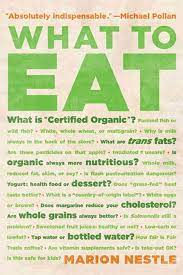
What to Eat , by Marion Nestle, 2006, is described on the back cover as “the one book that tells you everything you need to know about food, with clarity, insight, wit, and wisdom.” It is certainly comprehensive and very readable, but it would be more accurate to indicate that it has everything you need to know about food sold in supermarkets – not about which types of food to eat. Marion Nestle was a Professor of Nutrition, Food Studies and Public Health at New York University. She is well known as a public health advocate and an opponent of processed (junk) food and the major international food corporations that produce it and control most of the food sold in supermarkets throughout the world. Despite the title, Nestle doesn’t tell the reader what to eat, but gives enough information about the range of foods available in supermarkets to help us make up our own minds – or at least to better understand what we’re buying. When she mentions her own food or buying preferences, she exp...

The Search for Richard III: The King's Grave

Image
Most of us know a bit about Richard III – the hunchbacked killer of his two nephews, the Princes in the Tower of London. In Shakespeare’s play he is evil, scheming, and a pretender to the throne. However, there is evidence that he was loyal to his brother, King Edward IV, a fair and just king during his own short reign, and not clearly connected to the disappearance of his nephews. What we do know for sure is that he was killed on 22 August 1485 at the Battle of Bosworth, losing to Henry Tudor, who became King Henry VII. Legend had it that he was hastily buried in the Church of the Greyfriars without the pomp befitting a king who dies in battle. Fifty years after the battle, the church was destroyed at the time of the dissolution of the monasteries and Richard’s grave was never found. The Search for Richard III: The King's Grave , by Philippa Langley and Michael Jones, 2013, details the archeological search and discovery of Richard III’s skeleton in a car park on the site where...

Rasputin: Faith, Power, and the Twilight of the Romanovs

Image
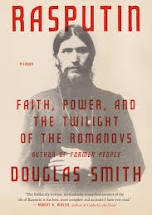
There are so many tales about Rasputin -- the Mad Monk who cast his spell over the last Tsarina of Russia and was a cause of the downfall of the Romanovs. He had a strange power to relieve the hemophilia symptoms of the Tsarevich Alexei, heir to the throne; he had perverse and unquenchable sexual appetites; he was the very personification of evil. Except that most of what we think we know about Rasputin is not true. In this biography by Douglas Smith, 2016, a clearer and more fascinating life of Rasputin is presented. Smith is an award-winning historian, and earlier had worked for the US State Department in the former Soviet Union and as a Russian translator and affairs analyst for Radio Free Europe. In the introduction to the book Smith writes that he was determined to search out the facts of Rasputin’s life by conducting extensive research, which he claims led him to seven countries, “from Siberia and Russia, across Europe, to Britain and finally the United States.” In addition, he...

The Surgeon of Crowthorne: a tale of murder, madness and the Oxford English Dictionary

Image
Truth really can be stranger than fiction. This book, by Simon Winchester, 1998, is about the relationship between an inmate in an insane asylum and the lexicographer responsible for compiling the first Oxford English Dictionary in the 19th century. It was the subtitle of the book that attracted me first: a tale of murder, madness and the Oxford English Dictionary.   Murder and madness certainly don’t seem to have anything to do with a dictionary and – when I found out the book was about how this impressive dictionary was first compiled – I was even more interested in reading it. The Oxford English dictionary was the first one in English that aimed to include every word in the language. As part of that endeavor, citations of the first use of the word and its history would be included (where possible). This was such a huge undertaking that the lexicographer in charge, James Murray, enlisted the help of volunteer readers throughout the English-speaking world. This help involved hav...

Extra Virginity: The Sublime and Scandalous World of Olive Oil

Image
My book choice in the Food category for the 2021 NONFICTION READER CHALLENGE is Extra Virginity: The sublime and scandalous world of olive oil , by Tom Mueller, 2012. The book is an overview of the history of olive oil: where it has been grown, how it has been produced; what it has been used for; and its cultural significance through the ages. Much of the book, however, is about the adulteration and fraud involved in olive oil production. He writes: “Olive oil is one of the most frequently adulterated food products in the EU; within Europe, the problem is particularly acute in Italy, the leading importer, consumer, and exporter of olive oil and the hub of the world olive oil trade.” The fraud involves mixing olive oil with other types of oil, but packaging it as “extra virgin” olive oil. From the packaging, it seems, it is difficult to know if the product is pure. Mueller gives information about how to taste – and test – olive oil in order to know if it’s the genuine, unadultera...

The Astaires: Fred & Adele

Image
I have been a Fred Astaire fan for most of my life, and I watched his films with Ginger Rogers, and others, whenever they were on television as I was growing up. Now I have the entire collection on DVD, and they still delight me. The Astaires: Fred & Adele , by Kathleen Riley (2012), was the first book I have come across that focuses only on the life and career of Fred and Adele Astaire together. Since it had the support and input of Fred’s daughter, Ava Astaire McKenzie, I figured it would be accurate and respectful, and it is. I knew quite a lot about Fred Astaire’s life (mostly from the book, The Fred Astaire and Ginger Rogers Book , by Arlene Croce, 1972), so I knew that he started his career as the partner of his sister Adele. And from most accounts, Adele was the more talented of the pair. It is hard to believe that there could be a more talented dancer of that time than Fred, however. Since there is no film footage (that I’m aware of) of Adele and Fred dancing together, ...

The Time Traveller's Guide to ... England

Image
I read two of Ian Mortimer's Time Traveller's Guides: to Medieval Engliand (2008) and to Elizabethan England (2012).  At first, I wanted  to read about Elizabethan England since I’m interested in the Tudors, in the Elizabethan Era and in Shakespeare. But I realized that much of the information about England in medieval times would still be true in Elizabeth’s reign. So it seemed to make more sense to read the earlier Guide first, and then get a better idea of how life – and England – had changed. These are principally history books, but with quite a difference. Mortimer writes as if the reader were a tourist who will visit Medieval and Elizabethan England. He addresses the reader directly; for example, in describing the approach to the city of Exeter (in the Medieval book) he writes,”  It is the cathedral which you will see   first. As you journey along the road you come to a break in the trees and there   it is, massive and magnificent, cresting the hill top in...

Longitude: The True Story of a Lone Genius Who Solved the Greatest Scientific Problem of His Time

Image
My second book for the 2021 NONFICTION READER CHALLENGE is in the category of Inventions – “Longitude: The True Story of a Lone Genius Who Solved the Greatest Scientific Problem of His Time,” by Dava Sobel, 1995. Dava Sobel is an “award-winning former science reporter for the New York Times , and writes frequently about science for several magazines, including Audubon , Discover , Life and Omni ,” according to the inner book jacket. The ‘Greatest Scientific Problem’ before the end of the 18 th century was how to determine longitude throughout a sea voyage. In 1714 the British Parliament created the Longitude Act, which set a huge monetary prize for a “Predictable and Useful” means of determining longitude. The ‘Lone Genius’ of the title is John Harrison, a self-taught Yorkshire clockmaker, who “invented a clock that would carry the true time from the home port, like an eternal flame, to any remote corner of the world.” But he was not awarded the prize money until 1773 (although n...

The Life & Death of St. Kilda: The Moving Story of a Vanished Island Community

Image
  The blurb at the back of this book by Tom Steel says, “The story of St. Kilda has seized the imagination of people worldwide.” But I had never heard of this island before I found this book while on vacation on the Isle of Skye, Scotland. St. Kilda is a group of the outermost islands of the Hebrides, 40 miles (64 km) west-northwest of the nearest island of the Outer Hebrides, North Uist,  w hich is a 2½-hour boat trip today. The islands are home to a variety of sea birds, including the world’s largest colony of gannets, as well as two types of wild sheep. It was in this extremely remote, small area that a community of people lived for at least 2000 years. They existed mainly on the meat and eggs of the sea birds and lived in a row of stone houses along one “street” on Hirta, the largest island of the group. There was little interaction between Hirta and the rest of the world, except for the British postal service and a government-supplied nurse. In 1930, the last nurse sent ...