Posts

Cod: A Biography of the Fish That Changed the World
Image
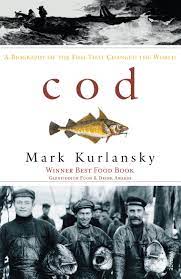
For the category Wild Animals of the 2022 NONFICTION READER CHALLENGE , I chose Cod, by Mark Kurlansky, 1999. The sub-heading of the book attracted me. I’ve read a number of non-fiction books about an item that ‘changed the world,’ such as coal, cotton and cement. I understand there is also a book about figs that claims the same thing. For some reason, I find such minute histories to be extremely interesting. Although I felt there was not enough support for how the codfish changed the world, I learned more information about the fish and the fishing industry than I ever thought I would know. This book was the winner of the Glenfiddich Food & Drink Awards as the Special Award Food Book 1999. I hadn’t known about that award, but it turns out that I had read one of the winning books ( Toast: The story of a boy’s hunger , by Nigel Slater). However, it was discontinued in 2008. I also like reading about the history of foods, for some reason. Even if they were not claimed to have ch...
The Big Necessity: Adventures in the World of Human Waste

Image
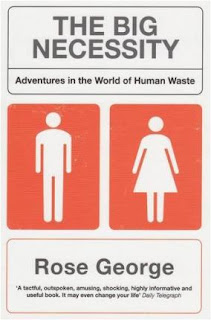
For the category Popular Science of the 2022 NONFICTION READER CHALLENGE , I chose The Big Necessity: Adventures in the World of Human Waste, by Rose George, 2008. The book focuses on practices of sanitation (i.e., toilets) in the world (or lack of them) and why this impacts everyone on the planet, as well as the planet itself. This seems like an unusual topic (one of the reasons it interested me), but also one that’s important yet rarely talked about. George refers to this many times throughout the book (“… we refuse to notice that we still don’t know how to properly deal with something that we all produce, up to several times a day, many million years after we first started producing it.”). However, some of the data she presents indicates why this should change. Lack of sanitation – or poor sanitation – affects almost everything about our lives, even if we live in a society that has effective sanitation. She starts with the statistic that 2.6 billion people don’t have sanitat...

Invisible Women: Exposing Data Bias in a World Designed for Men

Image
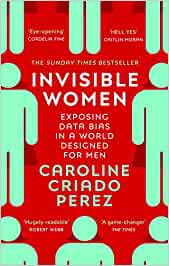
For the category Economics of the 2022 NONFICTION READER CHALLENGE , I chose Invisible Women: Exposing Data Bias in a World Designed for Men, by Caroline Criado Perez, 2019. Some things I already knew: women earn less than men for the same work; women do more unpaid work than men; women have fewer public toilet facilities, and medical studies generally use only men or more men than women, so are not necessarily relevant for women’s health (for example, heart attack symptoms). But there was so much more that I hadn’t realized – so much that the information became rather depressing. For example, I hadn’t realized to what extent the design of public spaces (streets, bus stops, public transportation routes, …) is based on data from and about men. As Criado Perez writes at the end of the section with chapters relating to different types of public spaces: “These are not niche concerns, and if public spaces are truly to be for everyone, we have to start accounting for the lives of ...

Kindred: Neanderthal Life, Love, Death and Art

Image
The book I chose for the 2022 NONFICTION READER CHALLENGE in the category Social History is Neanderthal Life, Love, Death and Art, by Rebecca Wragg Sykes, 2020. I checked the definition of ‘social history’ on Wikipedia to make sure I was on the right track: “a field of history that looks at the lived experience of the past.” This definition certainly suited this book, which I was planning to read anyway because I am very interested in archaeology and prehistory. As the title indicates, the book focuses on what is known about aspects of Neanderthal life – how and where they lived, what they ate, and what is now known about their culture. Almost everything most people think they know about Neanderthals is wrong. In the last two decades more has been discovered about their lives than in the previous century, and it is all fascinating. Instead of the unintelligent club-carrying thugs of the Stone Age, the Neanderthals were adaptable and extremely creative, being able to fashion delica...

Word By Word: The Secret Life of Dictionaries

Image
For the first book of the 2022 NONFICTION READER CHALLENGE , I read Word by Word: The Secret Life of Dictionaries , by Kory Stamper, 2017, in the category Language. Kory Stamper is a lexicographer for Merriam-Webster dictionary and writes about her experiences there by focusing on different words she has worked with and how they reveal peculiarities of the English language. In particular, it is quite a challenge to write a definition of a word, and she describes this in detail that is both fascinating and funny. She also reveals a lot of information about how a dictionary is created and updated, reflecting the changing nature of language. Each chapter focuses on one word (which is also the title of the chapter) to illustrate how it reveals some aspect of working with language. For example, the chapter “Irregardless” is subtitled “On Wrong Words” (and I was surprised to find out that she proves irregardless is not a wrong word!). The chapter “Bitch” is “On Bad Words;” “Nuclear” is ...

2022 Nonfiction Reader Challenge

Image
  At the beginning of 2021 I decided to join the Nonfiction Reader Challenge 2021, which I read about on the book blog Book’d Out. I decided to become a “Nonfiction Know-It-All” by reading 12 nonfiction books, one in each category listed on that website. I also read other nonfiction books, which I reviewed on this blog, but the ones for the Challenge (in this order) were: 1. Biography: The Five: The Untold Lives of the Women Killed by Jack the Ripper (Hallie Rubenhold) 2. Inventions: Longitude: The True Story of a Lone Genius Who Solved the Greatest Scientific Problem of His Time (Dava Sobel) 3. Food: Extra Virginity: The Sublime and Scandalous World of Olive Oil (Tom Mueller) 4. Indigenous Cultures: From Black Land to Fifth Sun (Brian Fagan) 5. Wartime Experiences: The Norman Conquest (Marc Morris) 6. Oceanography: The Sea Around Us (Rachel Carson) 7. Travel: Neither Here Nor There (Bill Bryson) 8. Disease: The Great Mortality: An Intimate History of the Black Death, The ...

Rationality: What It Is, Why It Seems Scarce, Why It Matters

Image
The final book I read for the 2021 NONFICTION READER CHALLENGE in the category Published in 2021 is Rationality: What It Is, Why It Seems Scarce, Why It Matters , by Steven Pinker, 2021. Steven Pinker is a cognitive psychologist at Harvard University and has written 8 books for general audiences on topics such philosophy, social relations and language. Being interested in language and how it develops, I’ve read his books The Language Instinct and The Sense of Style . I found that his writing is coherent and thought-provoking, so I wanted to try another theme and “rationality” seems particularly appropriate these days when it does, indeed, seem scarce. His book is structured in such a way that each chapter builds on the ideas and information in the previous ones. He starts with a focus on the ways that ‘rationality’ can be defined, and how it is evident or lacking in human beings. His examples include many logic problems, with explanations of why so many people cannot solve the pr...

Garden Bird Behaviour

Image
The book I read for the 2021 NONFICTION READER CHALLENGE in the category Hobbies is Garden Bird Behaviour: How to recognize and interpret everyday bird activities, by Robert Burton, 2005. I originally bought this book to learn more about the habits of some common birds in my garden – coal & marsh tits, sparrows, blackbirds, crows, (European) robin, and occasional newcomers. This book, however, gives information in areas common to all birds (e.g., “Birds try to choose food that gives a good return of energy for time spent gathering it. The basic rule is: not too big, not too small, but just right. For instance, Spotted Flycatchers prefer to hawk for medium-sized insects, such as hoverflies and blue-bottles.”). This guides readers to find out information by observing birds themselves. So it’s a beginner’s guide to bird-watching. Burton writes from a very personal viewpoint – the birds he observes, the seasonal changes that affect the birds’ behavior, and the memories he has of ...

Visiting Mrs. Nabokov and Other Excursions

Image
The book I read for the 2021 NONFICTION READER CHALLENGE in the category Essay Collection is Visiting Mrs. Nabokov and Other Excursions , by Martin Amis, 1993. I’ve never been interested in essay collections. Maybe I had to write too many essays throughout school and university. But any time I read a review of an essay collection that sounds interesting, I check it out in a bookstore and put it down again. So to find a book for the ‘essay collection’ category of this Reader Challenge, I decided to browse the essay shelf in the library. First the title caught my eye, and then the first sentence of the blurb on the back: “Fuelled by innumerable cigarettes, Martin Amis provides dazzling portraits of contemporaries and mentors alike: …” then follows a list of the people mentioned in the separate chapters. I was familiar with the author’s name, but had never read anything he wrote. Conversations with different people (of different levels of interest for me) sounded like something I cou...

The Artist's Way for Retirement

Image
The book I read for the 2021 NONFICTION READER CHALLENGE in the category Self-Help is The Artist’s Way for Retirement , by Julia Cameron, 2016 (subtitled It's Never Too Late to Discover Creativity and Meaning ). Although I don’t read – or need – self-help books, I needed to find one for this reading challenge. And this book seemed to offer some ideas that I could use. Cameron is an artist who has also written many books about creativity and the creative process. I had heard about her book, The Artist’s Way (written with Emma Lively), but have never read it. She explains that it “spelled out, in a step-by-step fashion, just what a person could do to recover–and exercise–their creativity.” Although I didn’t feel that my creativity needed to be “recovered,” it could certainly be “exercised” more vigorously. But before I looked into getting that book, I learned about this one and decided it was more appropriate for me since I was approaching retirement. In the introduction, Camero...

The Great Mortality

Image
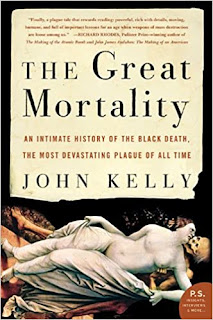
In the category Disease for the 2021 NONFICTION READER CHALLENGE , I read The Great Mortality: An intimate history of the Black Death, the most devastating plague of all time by John Kelly, 2006. It was particularly interesting to read about a pandemic during the Covid-19 pandemic. The plague is now often referred to as the Black Death, but it was known to Europeans at that time as The Great Mortality, which Kelly calls “the greatest natural disaster in human history.” In the introduction, he mentions writing about a patient who had AIDS in the early 1990s [ in a previous book ] , when there were no effective treatments, and writes, “A hallmark of a pandemic disease is its ability to destroy worlds, not just individuals, but it was one thing to know that, quite another to witness it.” And, he adds what was at that time “newly emerging illnesses such as Ebola fever, Marburg disease, Hantavirus pulmonary syndrome, SARS, and avian flu.” So, adding the Covid-19 virus brings this up to ...

The Bagel: The Surprising History of a Modest Bread

Image
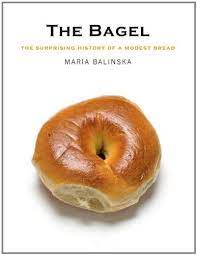
This book by Maria Balinska (2008) is, as the title states, about bagels. Why was I interested in reading about such a seemingly ‘modest’ food item as the bagel? First, I am a born and bred New Yorker, and fresh bagels from a bagel bakery had always been a part of my personal cuisine. Since living in other countries and travelling through other continents, however, I haven’t been able to find anything similar to a New York bagel. Either there is no equivalent at all or an item referred to as a bagel is merely a white roll with a hole. No comparison. However, I have been in places that claim to be the ‘birthplace’ of the bagel, but – curiously – they don’t sell anything resembling it now. Second, I am interested in the history of food and of foods. For example, I’ve read about chocolate, olives, olive oil, food in prehistory, beer, salt – but I was excited to find a book about the bagel. There are many myths surrounding its creation, so I thought I would find out the truth in this b...